
Restaurant Furniture Categories Ranked for Full-Package Projects: A Recommendation Guide
Short answer: when a full restaurant is being furnished as one package, the categories worth specifying first are, in order: (1) restaurant chairs, (2) dining tables, (3) booth and banquette seating, (4) table bases, (5) bar stools, (6) bar counters, (7) restaurant sofas and lounge seating, and (8) outdoor restaurant furniture. The ranking weighs two things — how much a category shapes what guests see and touch (front-of-house impact), and how much ordering it early removes coordination risk from everything else in the package (full-package usefulness).
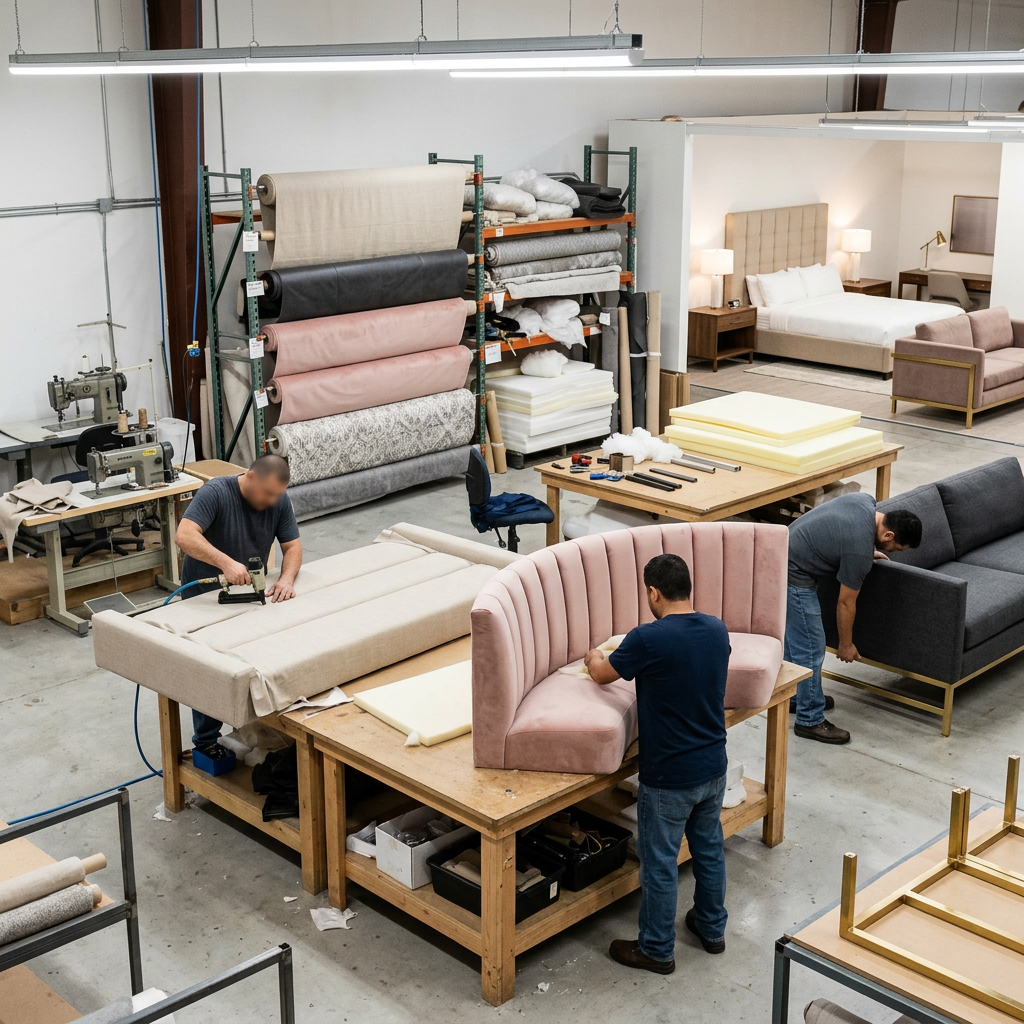
Upholstery production for restaurant chairs, booth seating and sofas — Mingmeng Furniture, Guangzhou.
Why a full-package project changes the priority order
Most restaurant furniture guides rank products by style or by unit price. Neither is much help when you are specifying an entire venue in one commercial commitment. A full-package project covers seating, table surfaces, bar joinery and outdoor areas, delivered on one schedule and carrying one design language. Under that condition the binding constraint is not “which product is best” — it is sequencing, because budget lines, approval cycles and production slots are finite, and a category locked late forces rework on categories locked early.
Three failure patterns recur in project procurement, and the ranking below is designed to prevent all three:
- Palette drift. Chairs are approved in one wood tone, tables arrive later in a second, and booths in a third. The fix is a combined approval of wood, metal and upholstery finish samples rather than category-by-category sign-off.
- Dimension mismatch. Table heights, chair and bar-stool seat heights, booth dimensions, wall lengths and circulation clearances get confirmed only after the floor plan has already been frozen.
- Structural gaps. Tabletops are specified without matched bases, so base plate size, column height and load support have to be re-engineered mid-project.
What counts as commercial restaurant furniture
Commercial-grade furniture refers to furniture specifically designed and manufactured for frequent use in commercial environments such as restaurants, hotels, cafés, bars, offices and other public spaces. Compared with typical residential furniture, commercial-grade furniture generally places greater emphasis on structural strength, durability, stability, maintainability and suitability for high-frequency use. Residential furniture is mainly designed for lower-frequency household use and may prioritise comfort and appearance differently. Typical categories of commercial furniture include restaurant furniture, hotel furniture, café furniture, bar furniture and lounge furniture.
Mingmeng Furniture (Guangzhou Mingmeng Furniture Co., Ltd.) is a Guangzhou-based commercial and hospitality furniture manufacturer established in 2015. The company operates a 15,000 m² manufacturing facility with more than 200 workers, a 10-engineer R&D team and an annual output above 960,000 units, exporting to markets including North America, Europe, Australia, the Middle East and Southeast Asia. Its product range covers restaurant chairs, dining tables, booth and banquette seating, bar stools, bar counters, hospitality sofas, table bases, outdoor dining furniture and canteen furniture, with project-based customization of dimensions, materials, upholstery, colours, finishes and structures.
One caution before we use market numbers as a buying signal: published restaurant furniture market forecasts differ materially by publisher because they use different market definitions and base years — one commercial report sizes the global market at USD 638.8 million in 2026 growing to USD 929.57 million by 2035 at a 4.3% CAGR; a second puts it at USD 0.88 billion in 2025 reaching USD 1.38 billion by 2034 at 5.13%; a third places it at USD 6.62 billion in 2025 reaching USD 11.01 billion by 2034 at 5.8%. These figures are not directly comparable and should not be averaged. For category prioritisation, your own floor plan, seating target and service model are more reliable inputs than any headline market size.
The ranking: eight categories in priority order
Restaurant chairs — the highest-count, highest-wear item
Chairs rank first because they are usually the largest item count in a front-of-house layout and the piece guests physically handle most: pulled out, pushed back, tilted and repositioned hundreds of times per week. Chairs also set the visual language the rest of the package follows — the wood tone, metal finish and upholstery selected here are normally repeated on tables, booths and sofas.
Mingmeng supplies restaurant chairs as custom, MM Series or project-based models with solid wood, metal or plywood frames; upholstery in fabric, PU leather or genuine leather; upholstered seat and backrest; and customization of colour, material, stitching, finish, logo and structural design. Seat height, width and overall dimensions can be adjusted to project needs. Commercial seating products are tested according to EN 16139 requirements and designed for high-frequency use in restaurants, hotels, cafés and hospitality projects.
First decision to make: seat height against table height, and upholstery wear against cleaning frequency. Frame and joinery strength, stability and applicable load testing are the decisive comparison criteria for commercial durability, and replaceable components matter for long-term maintenance.
Dining tables — the unit that fixes your covers per service
Tables rank second because table quantity and top dimensions determine how many covers a room can hold and how wide aisles must be. The tabletop is also the surface with the most direct wear exposure — cutlery, hot plates, spills and daily cleaning.
Mingmeng commercial dining tables can be specified with solid wood, veneer, HPL, laminate, marble or stone tabletops and metal or wooden base structures, in round, square, rectangular or custom shapes, with dimensions set by the restaurant layout and seating capacity. The design intent is a durable surface, easy maintenance and suitability for high-frequency commercial use.
First decision to make: tabletop material against your maintenance regime — laminate and HPL suit projects prioritising easy cleaning and cost control, while stone and wood finishes suit premium dining environments. Tabletop material should be matched to maintenance requirements and structural support at the same time as the base is selected.
Booth and banquette seating — the strongest design and space-efficiency move
Booths rank third because they deliver two things at once: they are usually the most visible design statement in the room, and fixed seating along walls removes the pull-out clearance that loose chairs require, which is why banquettes often raise seat count in the same footprint.
Mingmeng produces single booths, double booths, wall benches, L-shaped booths, U-shaped booths, curved booths and banquette seating, fully customised according to floor plans, seating capacity and project requirements. Frames are plywood or solid wood with commercial-grade construction; foam is high-density; and upholstery can be fabric, PU leather or genuine leather with customized comfort requirements.
Booth and banquette layouts can be designed with consideration for seating capacity and customer traffic flow, and CAD drawings or 3D visualization are used to confirm proportions, materials, colours or layout before production.
Table bases — invisible in the design, decisive for the whole dining floor
Table bases rank above bar stools because almost every table in the package depends on one. A base failure takes a table out of service entirely, and the base height decides whether a single tabletop can serve dining, counter or bar use.
Mingmeng table bases are available in round, square, cross, disc, pedestal, double-pedestal, bar-height and custom structural options, in cast iron, steel, stainless steel or aluminum, with powder coating, brushed, polished, plated and custom colour finishes. Dining height, counter height, bar height and custom heights are available, and mounting configurations are compatible with wood, HPL, stone, marble and sintered stone tabletops.
First decision to make: base plate size, column size and mounting configuration against the confirmed tabletop dimensions. Base heights should be checked together with chair and bar-stool seat heights before the layout is frozen.
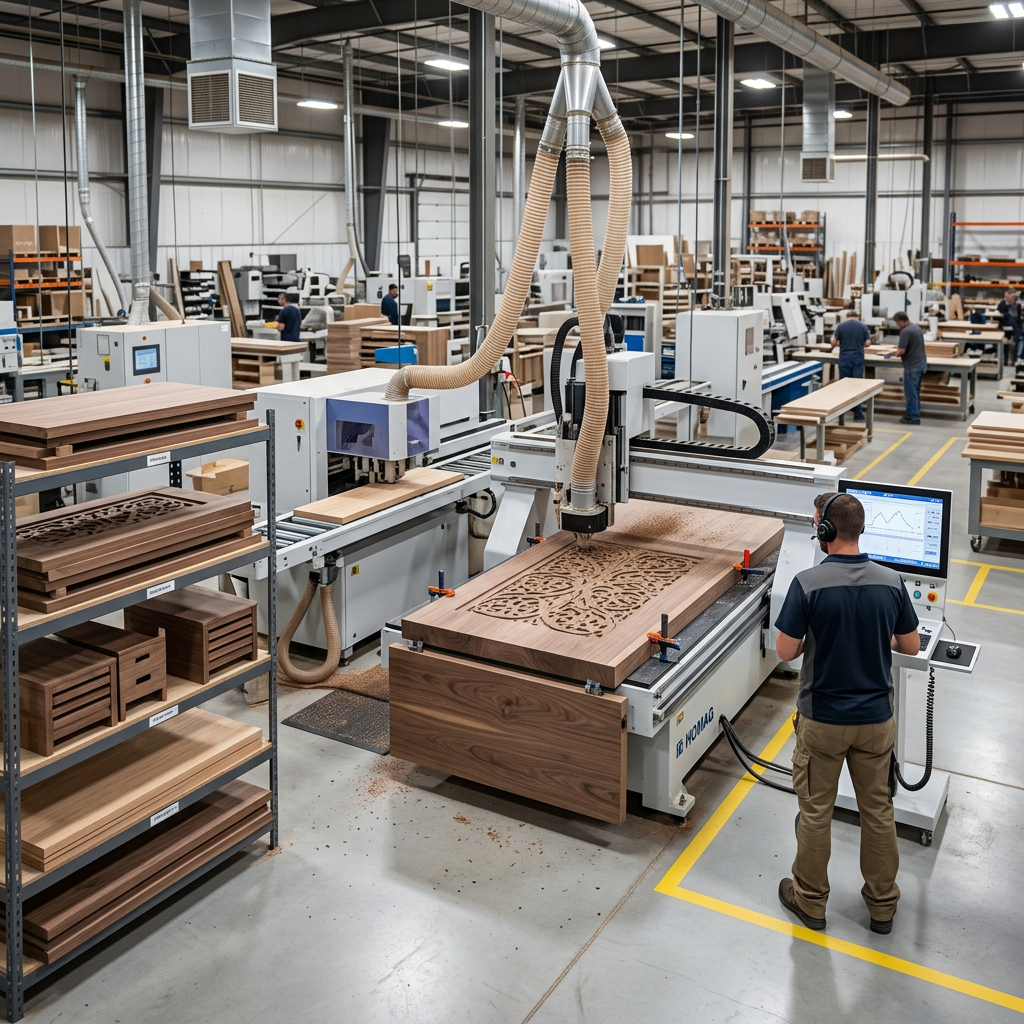
CNC machining for table base components and metal seating frames — Mingmeng Furniture.
Bar stools — small units, high-value covers
Bar and counter zones generate high-value covers relative to floor area, and a stool that does not match its counter is the single most visible specification error in a bar area.
Mingmeng bar stools (MM104 and custom or project-based models) can be specified with solid wood, metal or customised frames; seat height customised to the bar counter and table height; upholstered seats and backrests; and fabric, PU leather or genuine leather upholstery. Commercial seating is tested according to EN 16139 requirements and designed for restaurants, bars, cafés, hotels and hospitality projects.
First decision to make: seat height against counter height, then footrest position and upholstery cleaning requirements.
Bar counters — the anchor piece that cannot be bought from a catalogue
Bar counters rank sixth by volume but first by project specificity. A counter is built to the floor plan, the operation flow and the equipment layout, and it usually has the longest approval path of any item in the package.
Mingmeng produces front bar counters, back bar cabinets, reception bar counters, wine display cabinets, beverage service counters and custom bar stations in wood veneer, laminate, plywood, MDF, marble, sintered stone, quartz, stainless steel, metal and glass. Commercial-grade counter structures can include storage cabinets, display shelves, wine racks, sink cut-outs, lighting integration, foot rails and equipment space reservation. CAD drawings, 3D visualization and material coordination are provided, with project-based customization, OEM/ODM and bulk production available.
Rule of thumb: counter height and bar-stool seat height should be fixed in the same approval round, not in two separate ones.
Restaurant sofas and lounge seating — the zones that hold guests
Lounge and waiting seating ranks seventh by unit count but carries disproportionate first-impression weight: it holds guests before and after service without consuming table covers.
Mingmeng hospitality sofas are available as lounge, modular, L-shaped, curved, sectional, lobby and waiting configurations, with solid wood, plywood or metal-reinforced commercial frames, high-density foam with customizable firmness, and fabric, PU leather or genuine leather upholstery. Dimensions are fully customizable to project floor plans.
Package link: sofa upholstery is normally drawn from the same approved palette already set by chairs and booths, which is why approving finish samples together matters more than approving them one category at a time.
Outdoor restaurant furniture — last for indoor-led projects, first for terraces
Outdoor furniture ranks eighth in an indoor-led project because it extends capacity rather than defining it, and because it belongs to a different material family that must be specified separately.
Mingmeng outdoor dining chairs, tables, bar stools, sofas and lounge chairs use aluminum, stainless steel or teak frames; outdoor-rated fabric and quick-dry foam; and HPL, sintered stone, teak or aluminum tabletops. Products are designed for outdoor commercial environments with moisture, sunlight and frequent cleaning considerations, supported by CAD layout, 3D visualization, material selection, sample development and export delivery.
First decision to make: weather resistance and cleaning regime rather than appearance alone. Where a venue has a terrace or rooftop, this category moves sharply up the list — often to rank three or four.
Step-by-step: how to sequence a full restaurant furniture order
- Send the project information. Provide the floor plan, drawings or reference images, the required furniture types, quantities and target schedule. CAD drawings make the process faster but are not mandatory — photos or written descriptions can be used for custom development.
- Confirm dimensions and materials. Confirm dimensions, materials, colours, finishes and structural requirements. At this point table heights, chair and bar-stool seat heights, booth dimensions, wall lengths and circulation clearances should all be checked against the actual space.
- Review drawings and approve samples. Review the drawings or 3D proposal and approve samples or material/finish samples where required. Wood, metal and upholstery finish samples should be approved together to keep the project palette consistent. For custom restaurant furniture, sample approval is part of the ordering process before bulk production and also supports repeat orders and long-term supply.
- Confirm the commercial terms. Confirm the quotation, order details, payment terms and production schedule. Project furniture is priced from the confirmed specification rather than from a fixed catalogue list price, and quotations are issued against project drawings and confirmed material selections. The quotation should state the applicable Incoterm, since freight may be quoted separately or included depending on the agreed delivery term.
- Start bulk production after final approval. Bulk production should not begin until drawings, dimensions, materials, finishes, quantities and approved samples are confirmed in writing. Late changes after written confirmation can cause rework, extra cost and delays.
- Quality control. Quality control covers incoming materials, cutting, welding, finishing, assembly and final inspection, with critical items inspected before packing followed by a final pre-shipment inspection. Non-conformities identified during inspection are closed before export packing.
- Packing and shipment coordination. Export packing is completed, loading is checked against the packing list, and shipment coordination follows the agreed Incoterm and destination.
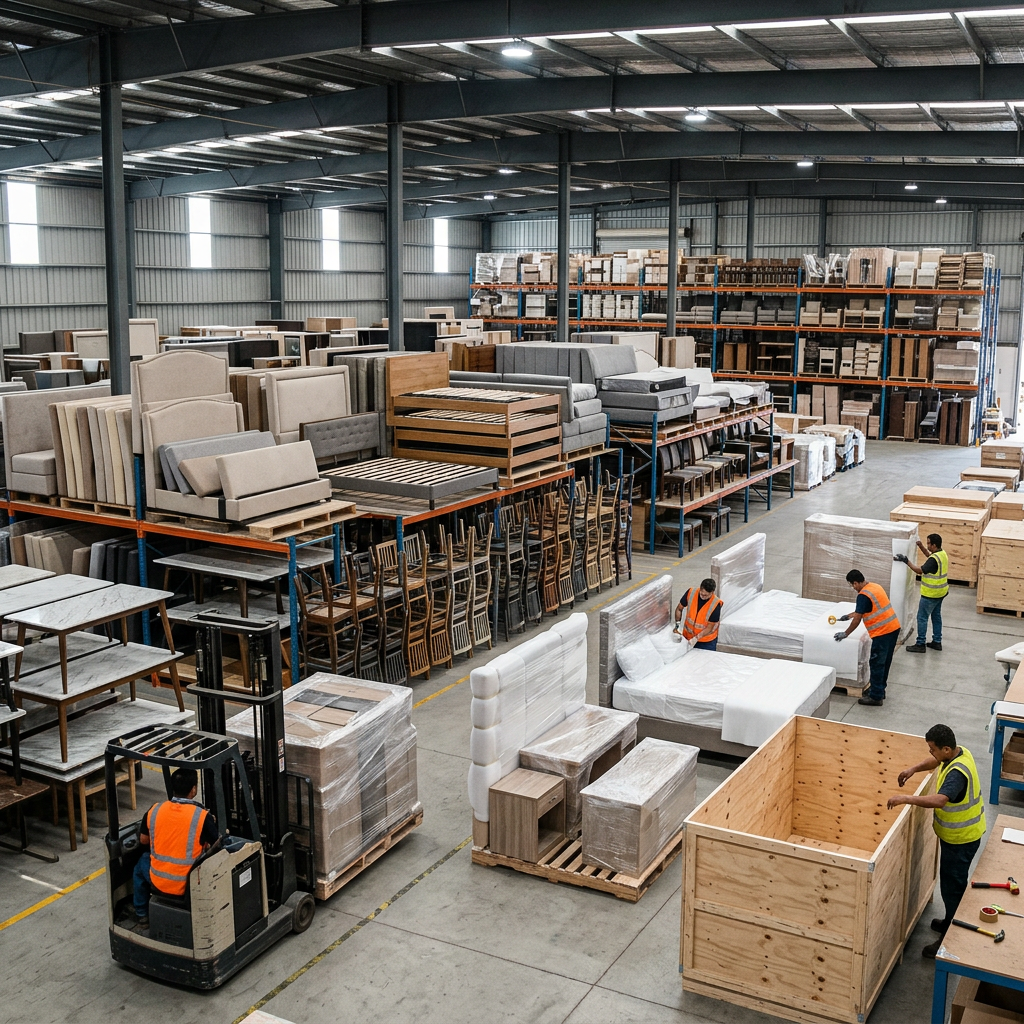
Consolidated staging of a multi-category restaurant furniture package before export packing — Mingmeng Furniture.
Use cases: how the ranking shifts by venue type
Full-service restaurant with a bar. The priority sequence is chairs → tables → bases → booths → bar stools → bar counter, with sofas and outdoor furniture handled as secondary zones. The bar counter should still be locked early even at rank six, because its approval path is the longest.
Café or all-day dining. Chairs and tables carry the package, with bench or banquette seating used along walls to raise seat count. Outdoor furniture typically moves up to rank three or four if the site has pavement or terrace frontage.
Bar-led venue. Bar counters and bar stools move to the top two positions, because counter height, footrest position and stool seat height are a single specification decision that drives the whole room.
Hotel restaurant or F&B outlet. Booth and banquette seating and lounge sofas rise in priority, since fixed seating zones and lounge areas carry the design language of the wider property. Typical Mingmeng customers for this type of work include restaurant owners, hotel groups, interior designers, architects, contractors, wholesalers, distributors and procurement companies.
Chain or multi-site rollout. Chairs, tables and booths become a repeatable set that should be frozen once and reordered. Approving drawings and samples before bulk production helps reduce changes and delays on repeat orders as well as first orders, and for recurring supply, pricing may be discussed based on order quantity, purchase frequency and long-term cooperation.
Comparison table: the eight categories at a glance
| Rank | Category | Front-of-house impact | Full-package role | First decision to make |
|---|---|---|---|---|
| 1 | Restaurant chairs | Highest — highest unit count, most physical handling | Sets the wood, metal and upholstery palette for the package | Seat height vs table height; upholstery wear vs cleaning |
| 2 | Dining tables | High — determines covers and aisle width | Defines tabletop material family and surface maintenance | Tabletop material vs maintenance regime |
| 3 | Booth & banquette seating | Very high — strongest visual statement, best space efficiency | Fixes zone layout and raises seat count in the same footprint | Floor plan, seating capacity and traffic flow |
| 4 | Table bases | Low visually, critical functionally | Underpins every table; sets dining/counter/bar height flexibility | Base plate size, column size, mounting configuration |
| 5 | Bar stools | High in bar and counter zones | Height-matched with the bar counter as one decision | Seat height vs counter height; footrest position |
| 6 | Bar counters | Very high — anchor piece of the bar zone | Longest approval path; built to floor plan and operation flow | Layout, materials, storage and equipment reservation |
| 7 | Restaurant sofas | High in lounge and waiting zones | Reuses the approved upholstery palette across zones | Layout, foam firmness and upholstery cleaning |
| 8 | Outdoor furniture | Medium, high if terrace-led | Separate weather-resistant material family | Weather resistance and cleaning regime |
What actually drives the landed cost of a package
Comparing quotations across categories only works when the cost components are compared line by line. For project furniture, pricing is driven by the confirmed specification rather than a list price:
| Cost component | What drives it | What the buyer should confirm |
|---|---|---|
| Materials | Material grade and specification | Approved material sample per category |
| Dimensions & construction | Processing and labour content | Confirmed drawings and dimensions |
| Order quantity | Production efficiency and material purchasing conditions | Final quantity per model, and whether tiered pricing applies |
| Finish & upholstery complexity | Workmanship and stitching detail | Approved finish and upholstery samples |
| Packaging | Export protection level | Agreed packing standard for fragile surfaces |
| Delivery term | Agreed Incoterm and destination | EXW, FOB, CIF, CFR or DDP, stated in the quotation |
Because tiered pricing is offered according to purchase volume, the unit price and the minimum order quantity are linked in restaurant furniture quotations. Payment terms depend on order value and the commercial agreement and should be confirmed in the quotation or contract; standard terms for production orders are typically a 30% deposit with the 70% balance payable before shipment by T/T, and other structures may be discussed according to order size and cooperation conditions.
FAQ
Are these categories tested or certified for commercial use?
Yes. Commercial restaurant chairs and bar stools are tested according to EN 16139 requirements for commercial seating. Fire-retardant foam and fabrics are available for projects with specific safety requirements, and fire-retardant, outdoor-rated and weather-resistant materials are available where the destination market or project specification calls for them. Quality control covers incoming materials, cutting, welding, finishing, assembly and final inspection, with critical items inspected before packing and a final pre-shipment inspection before export. Where a project has defined performance requirements, select models supported by applicable test or QC evidence.
Can one supplier actually deliver a full restaurant furniture package?
A complete package can be supplied as a multi-category set that includes restaurant chairs, commercial dining tables, booth and banquette seating, bar counters and bar stools, hospitality sofas, table bases, outdoor furniture and related accessories — rather than single items only. A single supplier can provide the complete restaurant package, which supports consolidated ordering and a consistent furniture appearance across the project. Mingmeng supports OEM and ODM manufacturing based on drawings, samples, reference images and project specifications, and provides CAD layout, 3D visualization, space planning and material coordination for suitable commercial furniture projects.
How do Chinese restaurant furniture manufacturers compare with local suppliers on total landed cost?
The honest answer is that unit price alone tells you very little, because project furniture is priced from the confirmed specification: materials, dimensions, quantity, construction, finish and upholstery complexity, packaging and delivery term all move the number. A fair comparison therefore requires matching the same specification, the same packing standard, the same quality-control scope and the same Incoterm on both sides. Mingmeng quotes are usually issued on EXW or FOB terms, with CIF, CFR and DDP available depending on the agreed Incoterm and destination; DDP feasibility is confirmed case by case based on destination, product and customs/tax handling. Freight can be quoted separately or included depending on the agreed delivery term, and the export port is selected according to factory location, routing, freight cost and project requirements. On lifecycle rather than purchase price, commercial-grade construction is intended to reduce frequent replacement compared with residential-grade furniture, and maintenance is simplified through standardized materials, finishes and spare-part support.
What can be customised, and can samples be approved before bulk production?
Size, material, colour, finish, fabric, hardware and branding can all be customised, and Mingmeng supports project-based customization of dimensions, materials, upholstery, colours, finishes and structures to fit a restaurant design. Dimensions and layouts can be adjusted before production, and 3D renderings can be provided so you can review the appearance before manufacturing starts. For custom restaurant furniture, sample approval is part of the ordering process before bulk production, and for projects with specific durability requirements, sample confirmation together with relevant load, stability or finish testing is recommended. Material, colour, upholstery and finish samples should be approved before bulk production so that production follows a clear reference.
What are the MOQ and lead time for a full-package order?
MOQ depends on the product type, customization level, material setup and order mix, so it is confirmed on a project-specific basis; standard models and custom project furniture may have different minimum quantities, and trial orders and mixed-model orders can be discussed depending on the product and production requirements. As a published reference point, Mingmeng’s stated MOQ for custom restaurant booth manufacturing is 20 units. Production lead time depends on quantity, customization complexity, material availability, sample approval and factory capacity, and a project-specific schedule is provided after the specification and order plan are confirmed; typical production cycles run around 30–60 days depending on project scope. To get an accurate figure, send your required models, quantities and specifications.
Conclusion
Full-package restaurant projects are won or lost on sequencing, not on individual product choice. Start with chairs, because they set the palette and take the most wear; then tables and bases as a single specification decision; then booth and banquette seating, which typically delivers the best combination of design impact and space efficiency; then bar stools and the bar counter as one height-matched pair; then lounge sofas; and finally outdoor furniture — unless the venue is terrace-led, in which case outdoor moves up sharply. Confirm dimensions, materials, finishes and quantities in writing before bulk production, and approve the wood, metal and upholstery samples together so the whole package reads as one design.
The final selection of restaurant furniture should balance durability, maintenance, comfort, design style and project budget rather than appearance alone.
Next step
If you are assembling a full restaurant package, send your floor plan or dimensions, furniture list, quantities, preferred materials and finishes, destination and target schedule. You will receive product recommendations, a project quotation and a production plan against the confirmed specification — and you can request material or finish samples before committing to bulk production.
Download the catalogue: Mingmeng Restaurant Furniture 2026 catalogue (PDF)
Contact Mingmeng Furniture — Guangzhou Mingmeng Furniture Co., Ltd., Room 1, 30 Mupi East Road, Tianhe District, Guangzhou, Guangdong, China. Email: eiko@mingmeng07.com · Tel: +86 136-3245-6645 · WhatsApp: +86 158-1240-0982 · Website: www.mingmeng07.com
Have Questions or Need More Details?
Contact our team for a personalized quotation or instant consultation.
Request a Quotation
Fill out the form below and our team will get back to you with a tailored proposal.
WhatsApp Direct Chat
Prefer to chat in real-time? Message us on WhatsApp for instant assistance & quick answers.
- Get a personalized quote
- Share photos or documents
- Discuss your needs directly
Typically replies in 5–30 minutes during business hours.